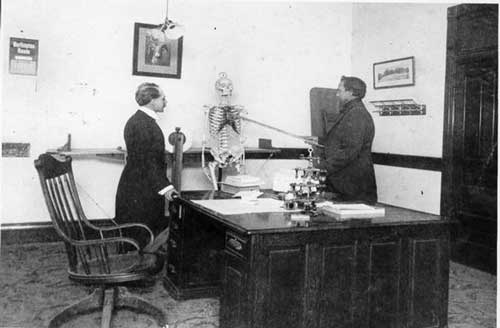
At the end of the 19th century, John Martin Littlejohn, a brilliant Scotsman with four doctorates, enrolled in the Kirksville school. In fact, because of his work as a journalist, he had gone to said place to interview Still, given that the fame of the ‘old doctor’ had begun to spread throughout several states. Littlejohn, in addition to being a journalist, was a specialist in physiology. Very quickly it became the right arm of A.T. Still and curiously, he was both a student and a teacher at Kirksville School, finally becoming dean of it.
He added the Academic Program Fundamental Sciences such as Chemistry, and highlighted the importance of studying physiology for health. According to Littlejohn: ‘Physiology is the gateway to the immense world of osteopathy.’
The defense of these fundamental sciences led him to frequent discussions with Still, since for the latter the important thing was ‘the structure’ while Littlejohn insisted on the importance of ‘the function’ as the main element. As a consequence of his different visions of medicine, he finally decided to move from Kirksville to Chicago, where he founded The Chicago College of Osteopathic Medicine, which became one of the most important schools in the United States. At Littlejohn we owe the development of a more maximalist and global osteopathy and especially the appearance of techniques such as T.G.O. (General osteopathic treatment later developed by J. Wernham), which is based on his own studies on human biomechanics and specifically on the action that the gravitational force has on the position. Europe. He settled in London, where he founded the British School of Osteopathy. This school will become the first European osteopathic institution and it still is today. Europe, the evolution of osteopathy followed a different path from the one that since the times of Still followed in the US. Thus, at present, in Europe, osteopathy is an independent profession, which is reached by obtaining the OD (Diploma in Osteopathy); While in the US, osteopathic doctors are studying medicine and ultimately specializing in osteopathy, but can, in their case, practice surgery and prescribe medication.
From the beginning of the 20th century to the middle of it, there was a tendency towards objectivity and rationalism in the field of osteopathy; to which Littlejohn himself and the appearance of the figure of Harrison Fryette contributed without a doubt, they then carried out treatments with a maximalist approach, leaving a little aside some of the principles of Still: ‘En-, Fix it and let it go on its way…’ In this way, most of the treatments at the time were based on direct manipulation techniques or thrust. The period between 1950 and 1975 approximately produces great changes in the vision that until then had osteopathy. This was due to the development of new approaches and the appearance of cranial and functional treatments. Figures like W.G.Suterland undoubtedly contributed to this with his revolutionary vision of the application of osteopathy in the cranial field. His work was continued among others by H. Magoun, V. Frymann and Anne Wales and perhaps represents the greatest evolution of osteopathy since the times of A.T. Still. Also noteworthy in this period: C.H. Bowles and H.V. Hoover with his evolution towards functional techniques; T.J. Ruddy and F. Mitchell with his muscular energy techniques; L.H. Jones with his tension-counter-tension maneuvers or Jean Pierre Barral who focused his attention on the development of visceral manipulations, and who today is one of the most popular authors. In 1960, the European School of Osteopathy (ESO) was founded, starting with the union of a group of renowned professionals, including J. Wernham, T. Dummer, T. Hall and P. Blagrave and the foundation for the development was laid. of new schools throughout Europe. In 1993, official recognition took place in countries such as the United Kingdom, France, Belgium, Switzerland, Portugal, Australia, New Zealand, etc. In 1997 the European Parliament urged the EU member states in the recognition of osteopathy (Lannoye Resolution 1997). For this purpose, the OSEAN (Osteopathic European Academic Network), was formed to promote cooperation in osteopathic training and to develop a unified academic curriculum in Europe; In the same way that the FORE (Forum for the Regulation of Osteopathy in Europe), is currently working to ensure that in the recognition of osteopathy there is a unification of criteria at the European level.
The document ‘WHO Strategy on Traditional Medicine 2002 to 2005’ recommends the use, promotion and development of osteopathy in the Member States. At present, there is a tendency to return to the holistic origin of osteopathy (apparently consistent with the initial conception by Still), giving the same emphasis to structural/functional/functional/structural dynamic aspects from both the diagnosis and the technique. In this way, each type of approach to treatment has been developed in the search for more subtle and precise elements to treat specific injuries; This implies that today, the osteopath has a large number of techniques to be able to adapt to each particular patient.
Osteopathy in Europe today
The development of osteopathy in Europe
The document ‘WHO Strategy on Traditional Medicine 2002 to 2005’ published in 2002 recommends the use, promotion and development of osteopathy in the Member States.
The World Health Organization (WHO) considers osteopathy a first-intention, independent health profession, and establishes training access to it in its document ‘Who Benchmarks for Training in Osteopathy’, published in 2010.
Said document defines the minimum training criteria for the practice of osteopathy and in turn establishes that osteopathy is a first-intention health profession independent of others such as physiotherapy or chiropractic.
The registry of the osteopaths of Europe was initially founded in 1992 for subsequently being called European Osteopaths Federation (EFO).
The EFO today brings together those professionals of osteopathy who meet the training criteria described by the WHO in relation to this profession. The Federation also coordinates the efforts of the national associations of osteopaths of the various European countries to achieve official recognition of osteopathy throughout the European Union (EU).
This federation therefore establishes the basic criteria for professional practice, as well as the Professional Code of Ethics and the minimum standards of training in osteopathy for the EU countries. In order to allow a clear identification of professionals among the public health care user in Osteopathy, the EFO created the qualification ‘EUR OST DO’, which is a registered identification that certifies that the osteopath who possesses it meets the academic and professional criteria described by the WHO and by the Federation itself.
The EFO acts as a representative organization of the European osteopaths before the three pillars of the European Union (Commission, Parliament and the Economic and Social Forum of the same). In this function, he also acts as a representative of the osteopaths in the European Council of Liberal Professions (CEPLI).
From the EFO, we want to avoid undue interference in national policies related to the profession; Bearing in mind that the regulation on health issues in the competition of the Member States; But at the same time, the different regulatory processes currently existing for the entire Union are supported.
EFO also collaborates with other osteopathic organizations such as the Forum for the Regulation of Osteopathy in Europe (Fore) or the European Registry of Osteopathic Doctors (EROP) in its efforts towards the recognition, regulation and free practice of osteopathy as an independent profession.
The EFO and the FORE, published in 2012 the document ‘The Scope of Osteopathic Practice in Europe’, to define the osteopath’s framework of competence. Almost in unison, the process of official standardization of osteopathy began in the European Committee for Standardization (CEN), with the creation of an official document for this purpose.
In 2015, and after several years of work, the European standard UNE-EN 16686: 2015 ‘Provision of health care services in osteopathy’, was finally published by the European Committee for Standardization (CEN-CENELEC). It establishes the common criteria, both academic and professional and ethical, that European osteopathy professionals must meet throughout the EU.
This standard is the result of consensus among all European standardization agencies in relation to the practice of osteopathy and its approval, it was published in the Official Gazette of the Spanish State (BOE) of January 21, 2016.